
Short answer: Long-term pricing that undercuts everything we rank, €99 buys three years, which is €2.75 a month, with five simultaneous connections stated on the front page. AirVPN publishes more technical detail than almost anyone and prices three years at a level our seven cannot match. Two things keep it out. Its own terms of service state that you may not use the service if you are a resident of Italy, which is an unusual restriction to find in a VPN contract. And we found no money-back window on the pages we read. A cheap three-year commitment without a stated refund route is a different kind of purchase from a cheap one-year plan with thirty days to change your mind. AirVPN is not in our ranking of seven, and this page says why rather than pretending otherwise.
The facts, and where they come from
Everything below is what AirVPN published on its own site on 6 September 2026, with the page we read it on. Where a detail was not stated there, the table says so rather than filling the gap from somewhere else. Prices were seen from Europe and differ by country.
Entry price | €15 for three months, €29 for six, €49 a year, €79 for two years and €99 for three |
Money-back window | Not stated on the pages we read |
Simultaneous devices | Five simultaneous connections per account |
Free tier | No free tier found |
Governing law | Not stated on the pages we read |
Our ranking | Not in our top seven, see below |
Checked on | 6 September 2026, airvpn.org |
A no-logs row is deliberately absent. Every provider states one, so the row would read "yes" every time and separate nobody; what separates them is an independent audit with a published scope and date, and that belongs in the text.
Why this one is not in our ranking
AirVPN publishes more technical detail than almost anyone and prices three years at a level our seven cannot match. Two things keep it out. Its own terms of service state that you may not use the service if you are a resident of Italy, which is an unusual restriction to find in a VPN contract. And we found no money-back window on the pages we read. A cheap three-year commitment without a stated refund route is a different kind of purchase from a cheap one-year plan with thirty days to change your mind.
That is not a warning. Our ranking is seven providers deep because seven is what we can keep current, and the order is decided by what we can verify on the provider’s own pages plus independent sources. The method is set out in our review methodology. A provider outside the seven is a provider we have less checkable evidence about, not one we are steering you away from.
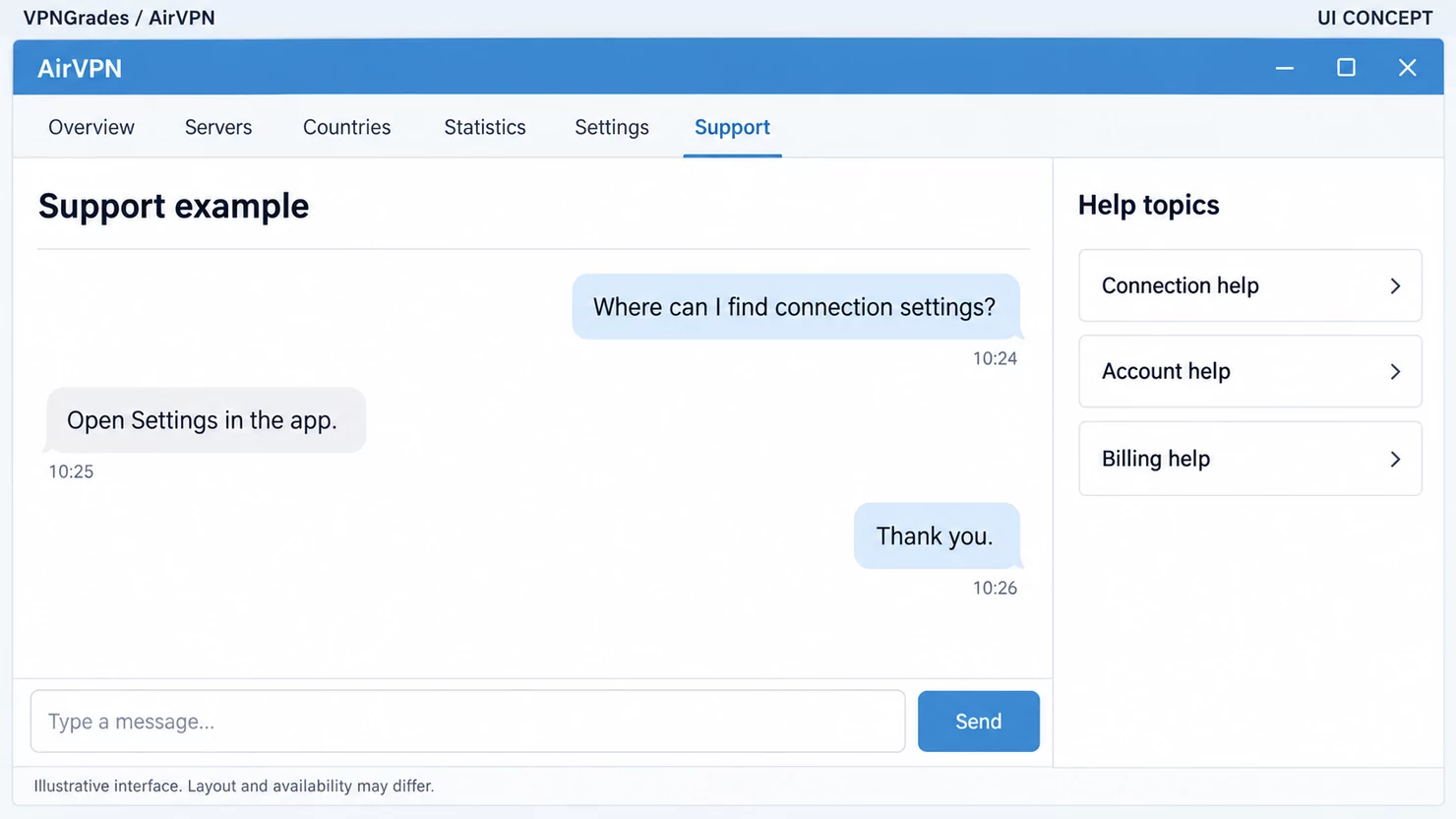
Where support and the refund window sit in the account area.
Where our commercial agreements sit in that is in the affiliate disclosure: they influence placement, not stated facts.
What we could not verify
This section exists because most review pages leave it out, and leaving it out is how a gap in the evidence turns into a confident sentence. Everything here is a question we tried to answer from AirVPN’s own pages on 6 September 2026 and could not.
The governing jurisdiction. Its legal pages did not state one in the sections we read.
The money-back window. Not stated on the pages we read.
Whether an independent audit of the logging policy exists, what it covered and when it was published.
Speed. We do not publish our own benchmarks, and no figure quoted anywhere is a measurement of your line.
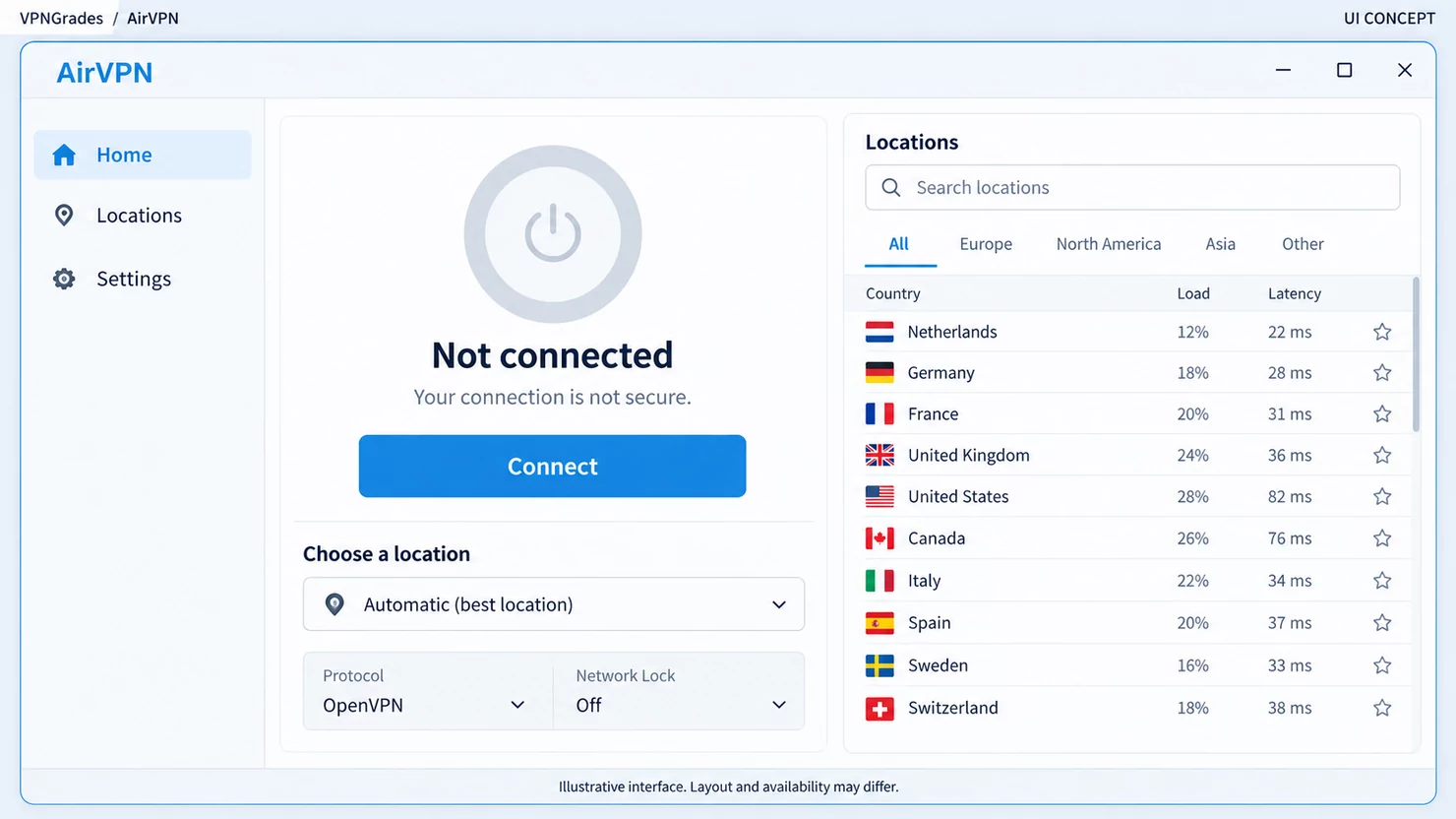
Where the connect button, the location list and the settings sit in the desktop app.
None of that means the answers do not exist: only that we did not find them where a buyer would look. Support can usually give them to you in writing, and a provider that answers promptly on those questions has told you something useful in the process.
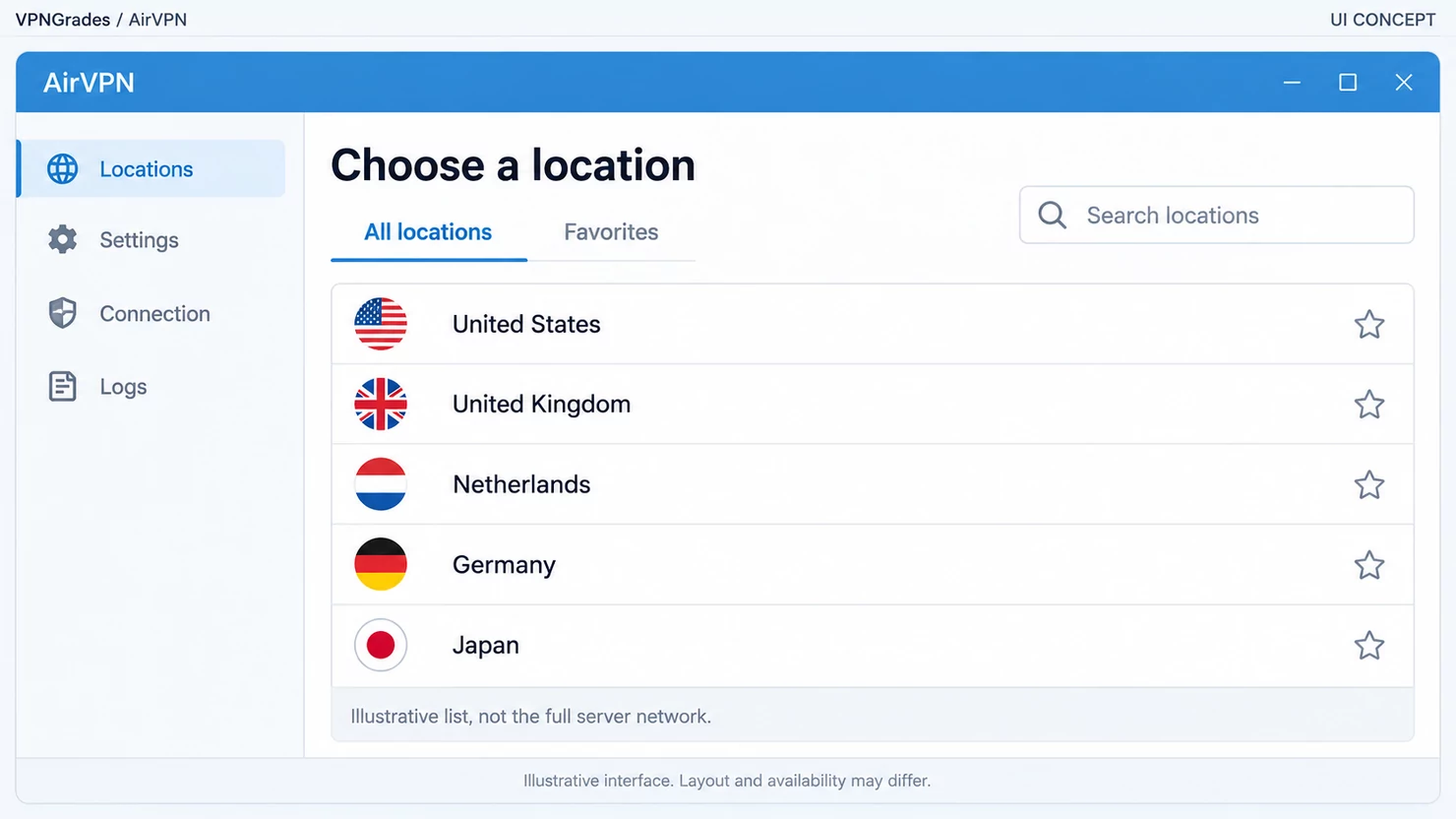
How the location picker is organised. The list is shortened for the illustration.
What we would compare it against
If AirVPN is on your shortlist, these are the seven we rank and what each one is for. Comparing across the two lists is the point of this page:
NordVPN: the safe default and our number one.
Surfshark: the cheapest full-featured plan on our list.
IPVanish: the one for routers and manual configuration.
Proton VPN: the privacy-first choice, and the only real free tier.
ExpressVPN: the premium option, priced like one.
Private Internet Access: configurable and cheap, registered in the United States.
CyberGhost: the most forgiving for a first-time user.
The buying guide under the table on the ranking page sets out what to weigh: jurisdiction, whether anyone independent has examined the logging policy, what you pay in year two, and the refund window as the only trial that means anything.
Privacy and logging
AirVPN’s own legal pages did not state a governing jurisdiction in the sections we read on 6 September 2026. That is a gap worth closing yourself before you rely on an answer either way. Their support can give it to you in writing.
AirVPN states that it does not log what you do online. So does every provider we cover, without exception, which is why that sentence tells you nothing on its own. What would lift it above marketing is an independent audit, and the scope matters as much as the existence, because "audited" covers everything from a full infrastructure review to a look at one desktop app.
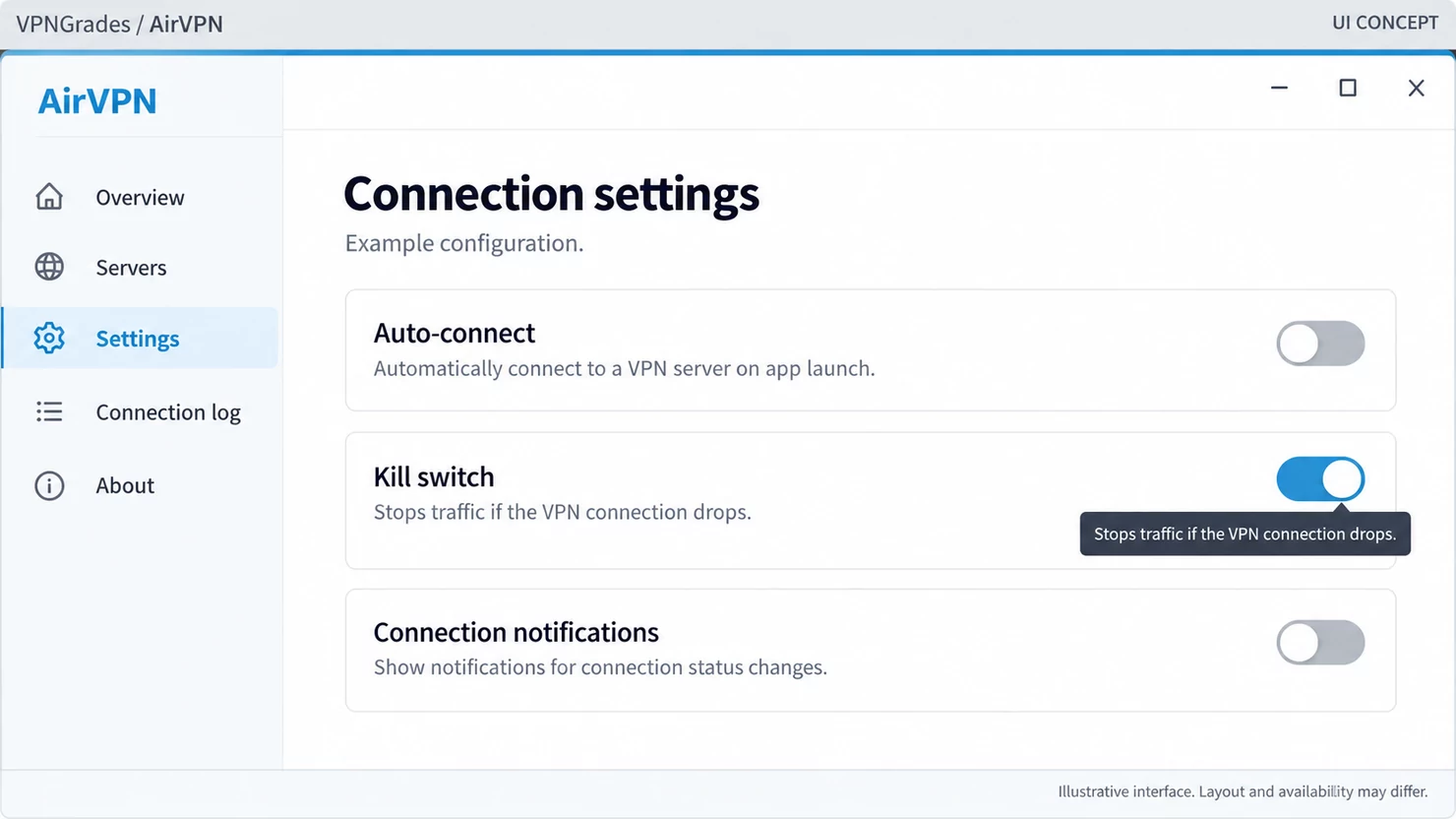
The kill switch and auto-connect live in the connection settings.
Jurisdiction decides who can compel a provider and through what process. It does not tell you whether anything is kept. For most people the threat is an untrusted network and an internet provider that logs, not a state actor with a court order, and for that, this question is a tie-breaker rather than a decision.
Streaming and torrenting
We do not publish a table of ticks saying which platforms work, because that table is out of date by the time anyone reads it. Streaming services identify and block addresses they associate with VPNs; the provider rotates, the platform blocks again. A route that works this morning can fail this evening, on the same server, from the same house.
AirVPN advertises that it works with particular services. That is the company’s claim about its own product and a reasonable one to make; it is not a guarantee, and no provider can honestly offer one.
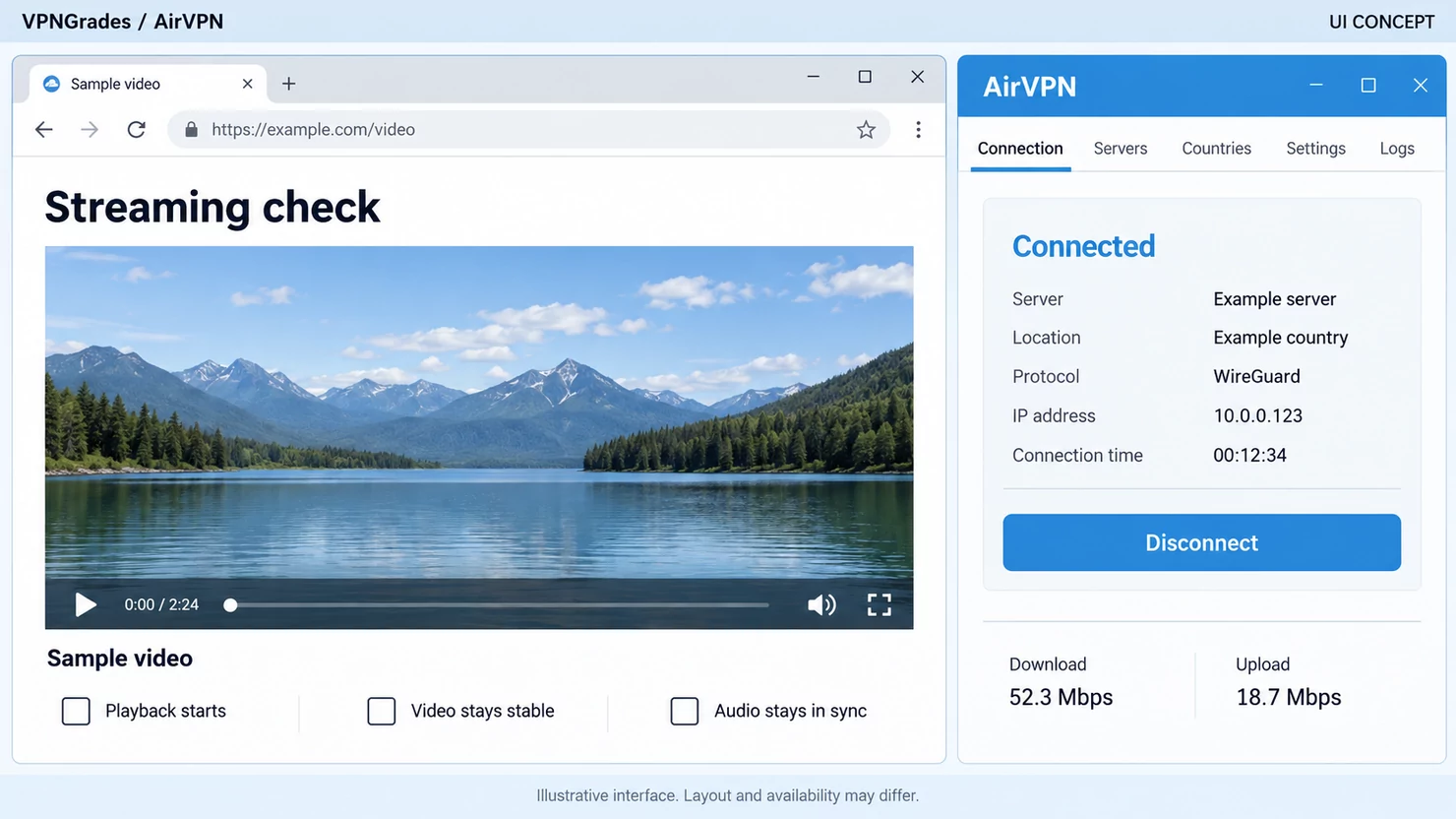
What a streaming check looks like when you test a service yourself.
Find out inside the refund window instead. Connect to the country whose catalogue you want, open the service on the device you will actually use, and play something for a few minutes. A page that loads is not a service that works. If it fails, try a second server in the same country before concluding anything.
Getting started, and what to check in the first week
The money-back window is a deadline, not a cushion.
Install AirVPN on the device you were thinking of when you bought it, and turn on the kill switch before anything else. It cuts the connection when the tunnel drops instead of quietly letting traffic out over your ordinary line, and it is off by default more often than it should be.
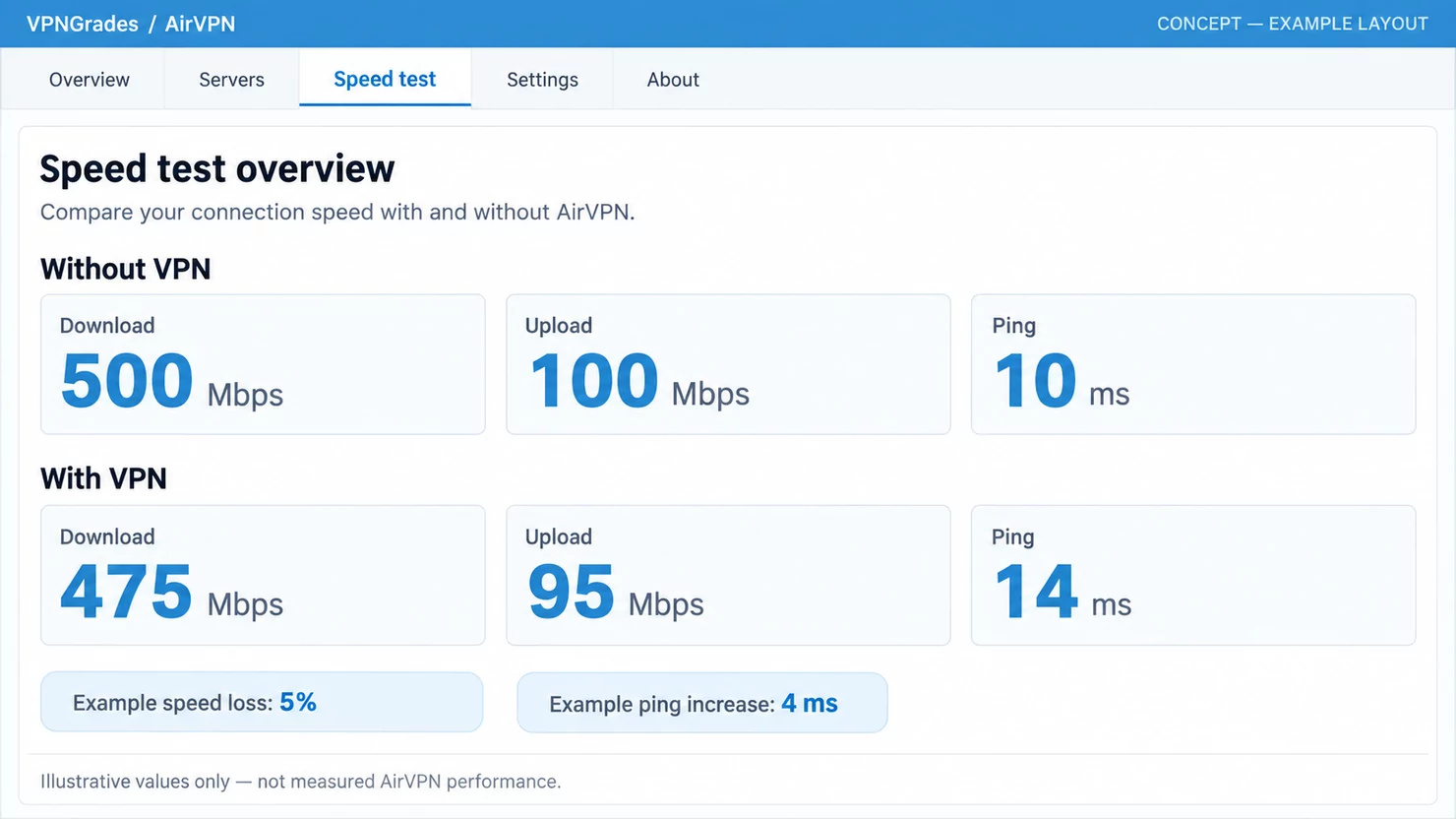
What a before-and-after speed test looks like. The figures are examples, not our measurements.
Then test the thing you bought it for, not a speed test. And if you own a television, a console or anything else without an app, the answer is the router: install once there and every device on the network is covered as a single connection.
Decide before the window closes. How a refund request goes is the one interaction almost nobody tests before subscribing and almost everybody has eventually.
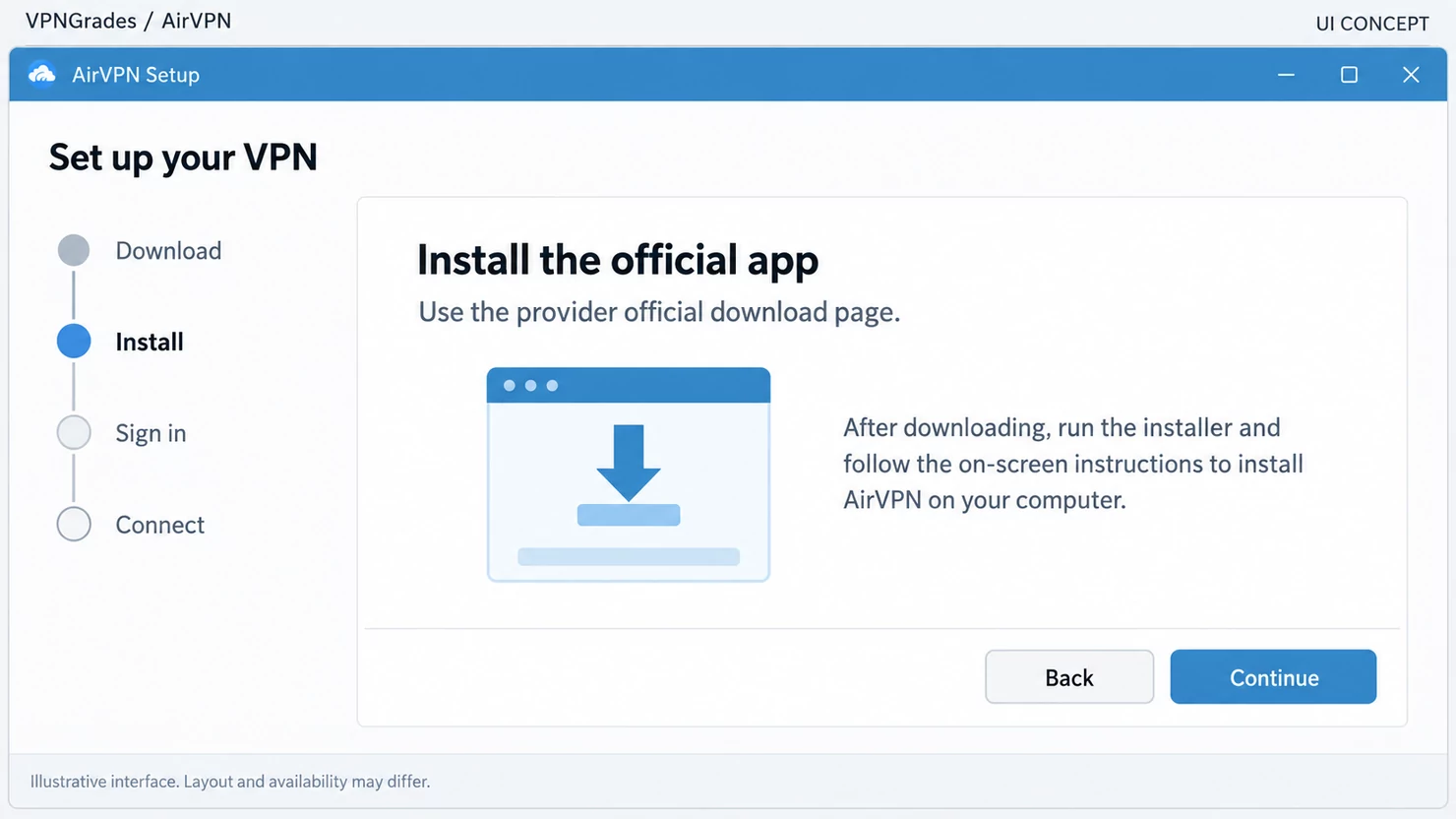
The install and sign-in steps, in order.
The verdict
Consider AirVPN if you want configuration depth and a long commitment at a low monthly equivalent, and you have read the terms yourself.
Look at our ranked seven instead if you want a stated refund window before committing to years. The ranking page puts them in order with the reasoning.
Either way the decision is provisional until you have run it on your own connection. That is what the money-back window is for, and it is the only part of buying a VPN where you get an answer instead of a claim.
What it does well
Device limit stated on its own site: five simultaneous connections per account
Pricing published openly: €15 for three months, €29 for six, €49 a year, €79 for two years and €99 for three
What to weigh against it
No money-back window stated on the pages we read
No governing jurisdiction stated on its legal pages
Not in our ranked seven: see the section above for why
Frequently asked questions
Is AirVPN worth it?
Long-term pricing that undercuts everything we rank, €99 buys three years, which is €2.75 a month, with five simultaneous connections stated on the front page. Whether that is worth it depends on which of those things you were shopping for. AirVPN publishes more technical detail than almost anyone and prices three years at a level our seven cannot match. Two things keep it out. Its own terms of service state that you may not use the service if you are a resident of Italy, which is an unusual restriction to find in a VPN contract. And we found no money-back window on the pages we read. A cheap three-year commitment without a stated refund route is a different kind of purchase from a cheap one-year plan with thirty days to change your mind.
Why is AirVPN not in your ranking?
AirVPN publishes more technical detail than almost anyone and prices three years at a level our seven cannot match. Two things keep it out. Its own terms of service state that you may not use the service if you are a resident of Italy, which is an unusual restriction to find in a VPN contract. And we found no money-back window on the pages we read. A cheap three-year commitment without a stated refund route is a different kind of purchase from a cheap one-year plan with thirty days to change your mind. Our ranking is seven deep because that is what we can keep current, and the order comes from what we can verify rather than from who pays us. The affiliate disclosure sets out exactly what commercial agreements can and cannot influence.
Does AirVPN keep logs?
AirVPN states that it does not. That is a claim by the company, not a finding by us. An independent audit with a stated scope and date is what would lift it above marketing.
How should I test AirVPN before committing?
Inside the money-back window, on the connection you actually have, doing the things you bought it for. In the first week rather than on the last day, so there is still time to ask for the refund.
Further reading
Best VPN Extension for Opera: where the free tier stops.
What Is a VPN on iPhone: how it behaves on that device.
Best Free VPN for Android: where the free tier stops.
Is The Big Bang Theory on Netflix: what a VPN does and does not change for a catalogue.