Hide.me Review: What the Free Tier Actually Gives You
The free tier can cover occasional browsing and basic privacy, but it is not equivalent to an unrestricted VPN subscription. Your decision should turn on data limits, server choice, speed, device use, and whether you need streaming or file sharing. The details per service are in our Private Internet Access review.
The free plan is presented as having no data limit.
Free access comes with a smaller server network and slower speeds.
Torrenting, port forwarding, and some advanced controls are restricted.
The core security protections are described as available to free users.
Occasional users may be satisfied; frequent users will likely want more.
What hide.me’s free VPN tier includes
For a free VPN, the central question is not whether the app connects. It is what remains usable after the connection is made. The available evidence points to a practical entry-level service: unlimited data, a limited choice of locations, and restrictions that matter more when you use a VPN every day. That makes this review hide me vpn readers can use as a decision guide rather than a simple thumbs-up or thumbs-down. For a side-by-side view, see our Private Internet Access review.
Supported devices and operating systems
You can approach the free tier through the provider’s supported applications, but the available source material does not establish a complete, current list of operating systems. You should therefore check compatibility for your particular desktop, phone, or tablet before relying on it. A VPN that works on one device is not automatically suitable for your whole household.
The practical distinction is between having an app and having enough simultaneous access for your routine. The free-plan evidence describes one device connection, so switching between a laptop and phone may be part of the experience rather than something you can do concurrently.
Free server locations and connection options
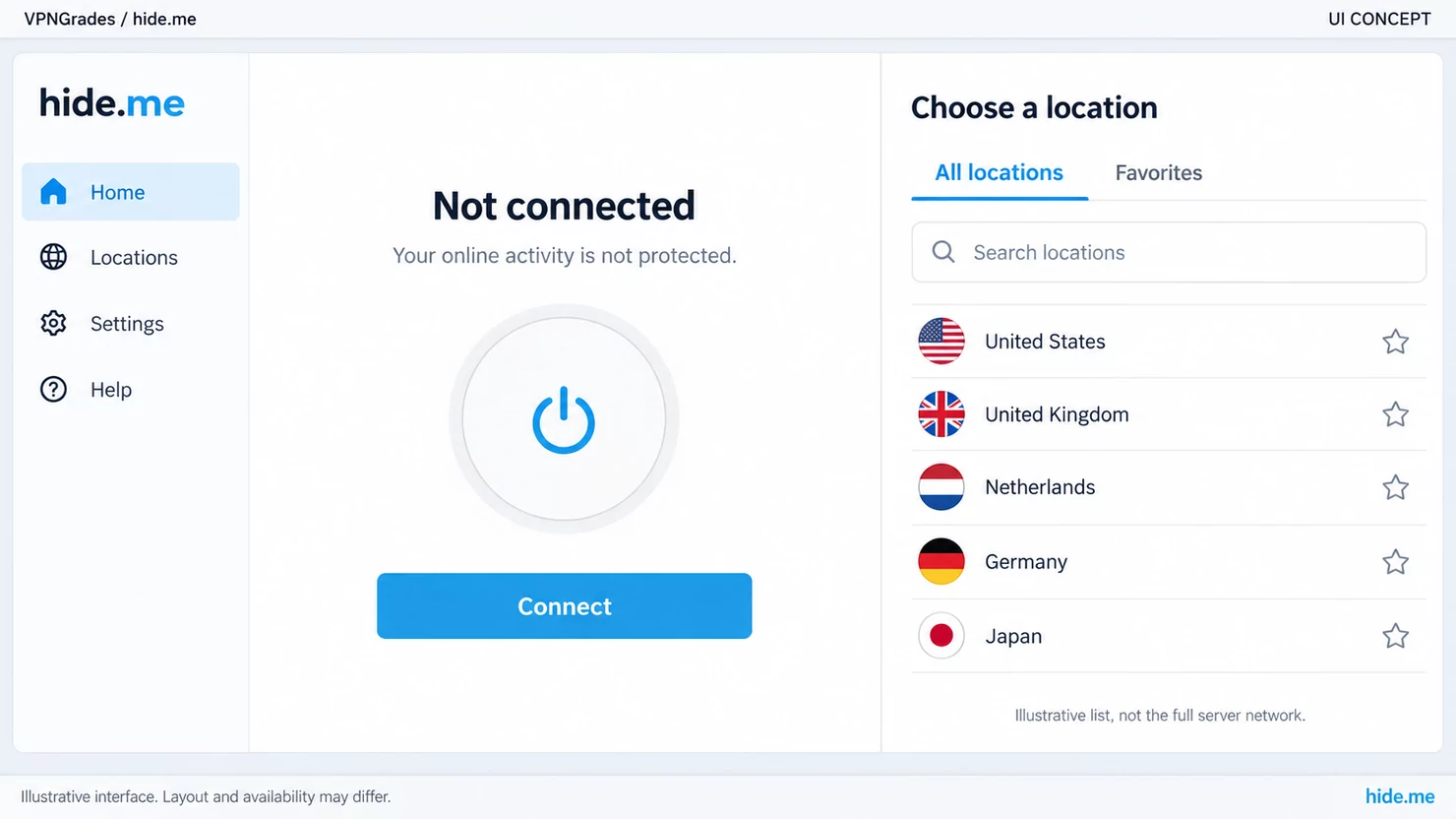
The free version is described as offering seven server locations. That is enough to test whether a nearby connection works well for you, but it leaves less room to change routes when one location is crowded or unsuitable. Server choice is especially relevant when your priority is speed rather than simply encrypting a connection.
You may also want broader context before comparing plans. A guide to free VPN for Android can help you think through the trade-offs between location choice, data access, and mobile use without treating every free service as interchangeable.
Data allowances, speed limits, and account requirements
The free plan is described as having no bandwidth limit, while also imposing slower speeds. Those two points belong together: unlimited data does not mean unlimited performance. You can browse for as long as you like, but large downloads and high-resolution media may still be frustrating.
The available material indicates that an email address is required, with no other personal information needed to get started. Treat that as a description of the sign-up route, not as proof that your wider online activity is anonymous.
Features available without paying
The free version is described as retaining the same core security protections as the paid plans. It also includes access to the WireGuard protocol according to the available testing summary. Those are useful foundations, but they do not remove limits on speed, locations, or advanced functions.
A free plan is easier to judge when you separate protection from convenience. Encryption and a protocol option may be enough for café browsing, while a larger network and configuration controls matter more for regular work, travel, or media use.
How the free plan performs in real-world use
Your experience will depend on distance to a free location, local congestion, device hardware, and the network you start from. Published testing summaries describe browsing as serviceable but free speeds as poor or slow, so you should not treat a no-data-limit promise as a performance guarantee. The fairest expectation is functional privacy with a willingness to compromise.

Connection setup and time to connect
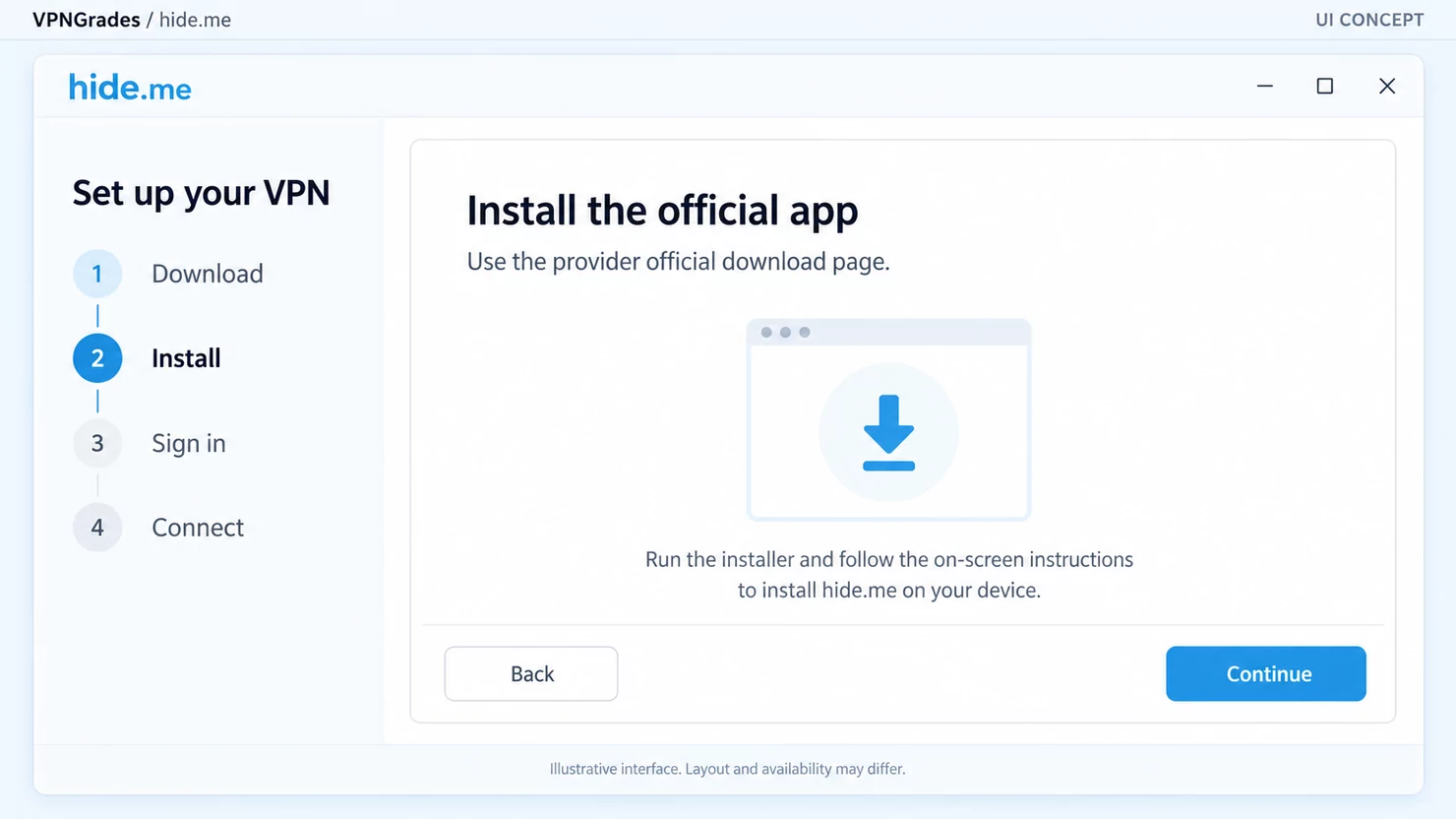
The available sources describe the service as simple to install and use, but they do not provide a controlled connection-time measurement for the free tier. In practice, the useful test is whether you can connect without repeated retries and whether the selected location remains available. A quick first connection can still be followed by disappointing performance.
You should test the service on the networks where you actually use it. Home broadband, a workplace network, and public Wi-Fi can behave differently, particularly when captive portals or restrictive firewalls are involved.
Download and browsing speeds
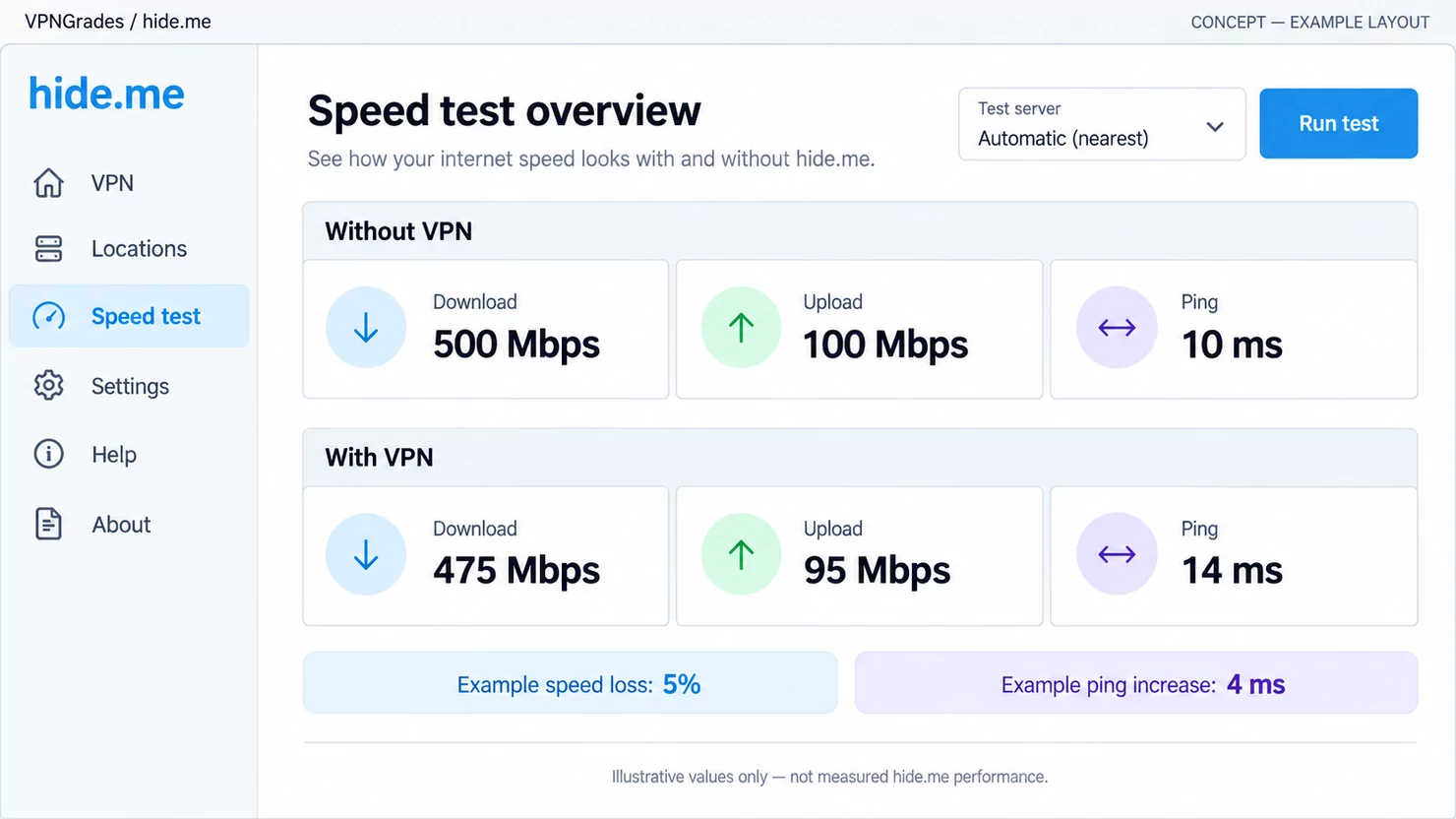
Free-tier speed is the clearest weakness in the available evidence. One testing summary calls free speeds poor, while another describes browsing as serviceable but not suitable for comfortable streaming. That suggests ordinary pages may load acceptably, but large files, image-heavy sites, and video can expose the restriction quickly.
No data limit means little if the connection is too slow for your normal tasks. Measure pages and downloads at different times instead of judging the plan from one successful connection.
Reliability during longer sessions
There is not enough authoritative material here to promise a particular uptime or uninterrupted session length. Longer sessions can reveal congestion that a short browsing test misses, especially when your free location options are limited. You should pay attention to reconnects, speed changes, and whether the app remains connected when your device sleeps.
A reliable result is therefore personal and situational. If a connection works for ten minutes but becomes unstable during a work call or download, the free tier may not meet your actual requirement.
Performance on mobile and public Wi-Fi
Mobile use adds variables such as changing cellular coverage, battery-saving behavior, and movement between networks. Public Wi-Fi adds captive portals and unknown congestion. The free tier can be useful for short sessions on those networks, but the slower-speed limitation means you should avoid assuming that every café or hotel connection will feel responsive.
The sensible test is simple: connect only after the network login works, browse several ordinary pages, and then try the activity you care about. If the connection fails at that point, the VPN has not solved the practical problem you brought to it. For a side-by-side view, see how the services compare.
What the free tier cannot do
A free VPN plan is defined as much by its exclusions as by its included tools. The available information identifies restrictions around torrenting, port forwarding, advanced features, and performance. Streaming access is also an uncertain proposition when free servers are crowded or blocked, so you should not buy into the tier expecting a dependable media-unblocking service. That comparison is set out in our Private Internet Access review.
Streaming platform access and media restrictions
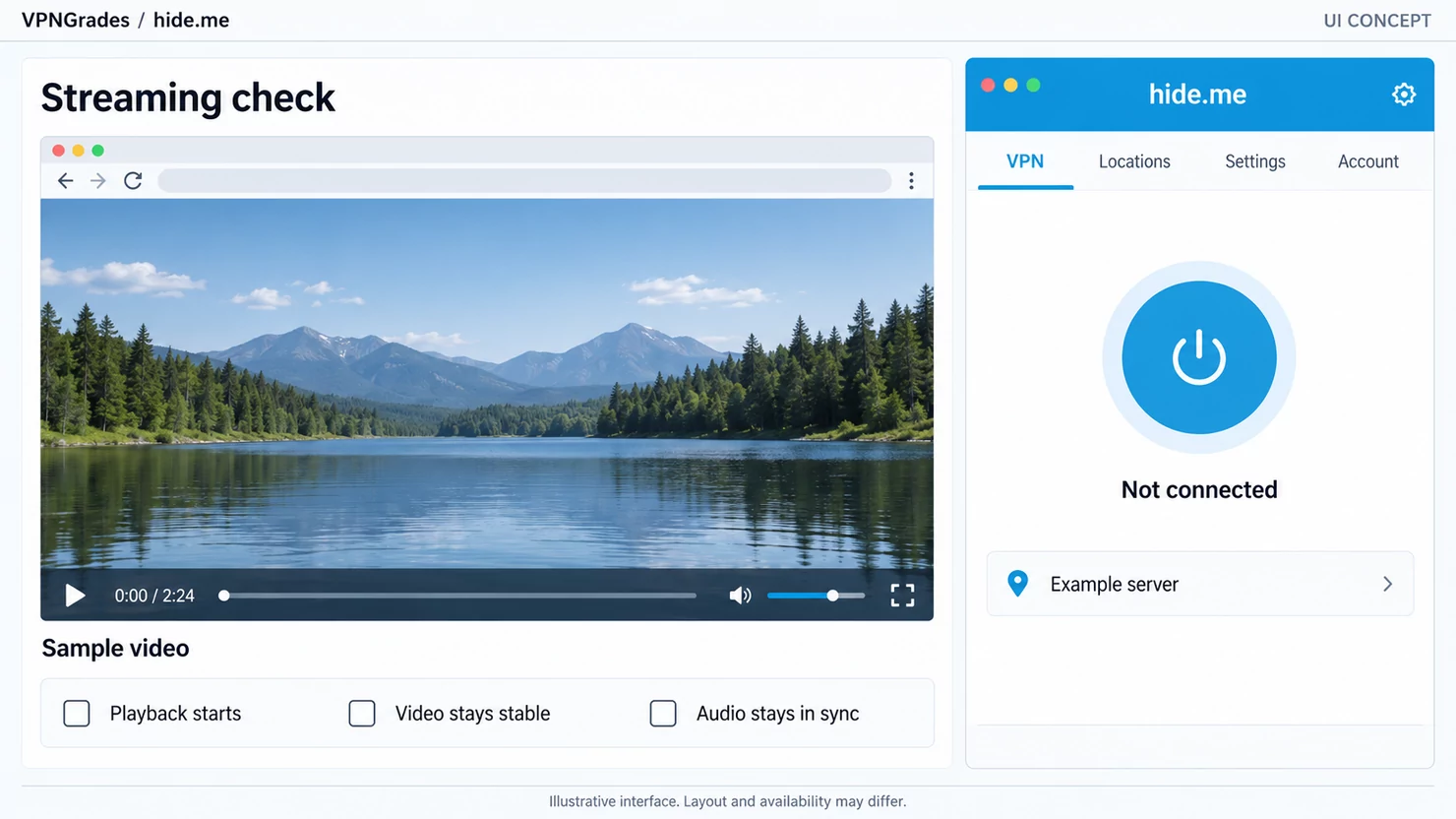
Testing summaries report difficulty with regional catalog access and describe choppy visuals and long loading times during streaming. That does not establish a universal result for every platform or location, but it is enough to make streaming a poor basis for choosing the free tier. You may connect successfully and still fail to reach the content you wanted.
If media access is your main purpose, verify the specific service and location during a current trial rather than relying on a general VPN label. Free server congestion can change the result without warning.
Torrenting and other bandwidth-intensive activities
The available evidence says the free plan does not support torrenting and restricts port forwarding. That removes important functionality for users who need peer-to-peer transfers or inbound connection control. It also makes the plan a poor fit for routine large-file activity, even though the plan is described as having no bandwidth limit.
High-volume use can expose several limits at once:
slower transfer speeds;
fewer locations to test;
no torrenting support;
no port forwarding.
Those restrictions are practical, not merely technical. If your task depends on peer-to-peer support, the free tier is the wrong starting point.
Device limits and simultaneous connections
The free-plan material describes one device connection. That means you should not assume you can protect a phone and laptop at the same time, or share the account across a family’s devices. A single connection may be adequate for occasional personal browsing, but it becomes inconvenient quickly when your routine moves between screens.
Check the device rule at the point of sign-up because plan terms can change. Do not confuse installing an application on several devices with being allowed to connect all of them simultaneously.
Missing premium features and configuration controls
The free plan is described as limiting advanced features and omitting port forwarding. The source material does not provide a complete feature-by-feature inventory, so it would be misleading to list every premium control as unavailable. The safe conclusion is narrower: you should expect a more restricted configuration experience than on a paid plan.
That matters if you want to fine-tune routing, choose from a broad network, or use specialist connection features. For straightforward privacy on one device, the missing controls may never matter.
Privacy and security in the free version
Security claims deserve separate treatment from speed and convenience. The available material says that the free version has the same core security protections as the paid plans and that the privacy policy applies to free users. Those statements describe policy and product design; they do not independently prove that every real-world connection is leak-free or that every privacy risk disappears.

Encryption protocols and kill switch behavior
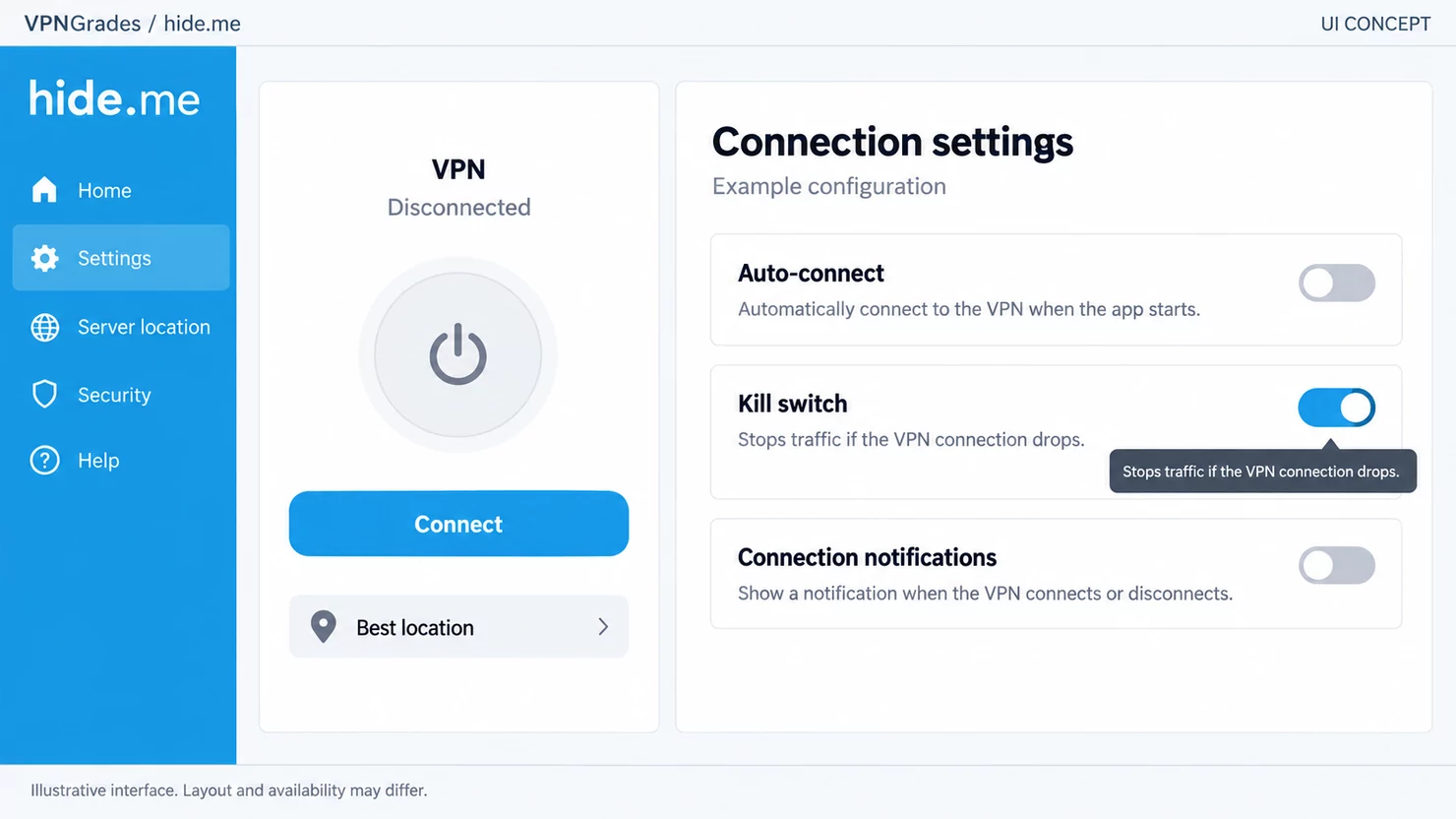
The sources describe core security protections across the free and paid versions and specifically mention WireGuard as available in the free experience. They do not provide enough detail here to make a complete claim about every protocol setting or every kill-switch condition. You should inspect the app’s current settings and test what happens when the network drops.
A kill switch is useful only if it behaves as expected during a failure. Connect, disable the network briefly, and confirm whether traffic stops before using the VPN for sensitive work.
Logging policy and what it does not prove
The available summaries say the provider assures users that its privacy policy applies to free users and that no logs are kept. That is a meaningful policy position, but a policy is not the same as continuous independent proof. You still need to read the current policy, understand what account information is retained, and distinguish operational data from activity logs.
A no-logs statement reduces one category of concern; it does not make every online action anonymous.
That distinction helps you set realistic expectations. A VPN can mask your connection from some network observers while websites, accounts, cookies, and device identifiers continue to create their own records.
Jurisdiction, ownership, and transparency
The available material identifies the company as Malaysia-based and refers to privacy credentials and transparency reporting in third-party summaries. It does not provide enough authoritative detail here to assess ownership structures, legal exposure, or the scope of any audit. Those are questions to verify directly from current first-party documentation.
You should be wary of turning a location or a marketing phrase into a complete privacy verdict. Jurisdiction is one factor among policy wording, technical design, transparency, and how you use the service.
DNS leak, IP leak, and WebRTC leak protection
The supplied sources do not establish a tested result for DNS, IP, or WebRTC leaks on the free tier. You should therefore avoid treating leak protection as proven simply because a VPN connection icon appears. If those leaks matter to you, run current checks while connected and repeat them after changing networks or protocols.
The result can depend on your browser, operating system, and local network. A clean test is useful evidence for your setup, not a permanent guarantee for every future connection.
hide.me’s apps and everyday usability
The app experience is part of the free plan’s value because restrictions are felt through menus, switching, and reconnecting. Available summaries call installation and use simple, while another describes the interface as potentially overwhelming for beginners. You should judge usability by the number of decisions you need to make, not by how many options appear on screen.
Desktop and mobile app experience
The available material supports a cautious conclusion: getting started is described as easy, but the wider interface may not feel equally simple for everyone. On a desktop, extra controls can be useful when you want to experiment. On mobile, the best experience is usually the one that lets you connect, verify the status, and disconnect without hunting through menus.
Your own device and network should be part of the test. An app that feels clear on a laptop may feel less convenient on a small screen or when the phone changes from Wi-Fi to cellular data.
Settings that matter to free users
Free users should focus on settings that affect whether traffic continues outside the VPN, which protocol is active, and how the application behaves after a network change. The available evidence confirms access to WireGuard but does not document every setting in the current app. Avoid assuming that a setting exists just because another VPN offers it.
Start with a small set of checks rather than changing everything at once. That makes it easier to identify whether a later problem comes from the network, the protocol, or an application setting.
Ease of switching servers and protocols
The free tier’s seven locations give you some choice, but switching is naturally less flexible than using a broad paid network. WireGuard is identified as an available option in the free experience, although the supplied material does not establish how every protocol performs on every device. Test a nearby location first, then compare another available route if the connection is slow.
Do not assume that changing protocol will overcome a crowded server or a platform block. It may help with connection behavior, but it cannot remove the plan’s location and access restrictions.
Common friction points and unexpected limitations
The recurring friction points are slower speeds, limited locations, one-device use, and restrictions on torrenting and port forwarding. None is fatal for occasional browsing, but together they can make the free tier feel narrow. You may also encounter different results depending on the time of day and the network you use.
That is why a short, realistic test is more useful than a generic feature list. Try your ordinary browsing, one longer session, and any activity you consider essential before deciding.
Free hide.me compared with the paid plan
The paid comparison is less about whether the free tier works and more about how much compromise you are willing to accept. The source material describes premium plans as removing several free-plan restrictions, while the free version retains core security protections. Pricing and plan terms are not included in the authoritative material supplied here, so a value judgment should avoid invented figures.
Which restrictions disappear after upgrading
The available information indicates that upgrading removes or eases limits associated with the free tier, including slower speeds, the smaller free network, torrenting restrictions, port forwarding, and some advanced features. It does not provide a complete current comparison table, so you should confirm each feature before subscribing.
The upgrade is most meaningful when a restriction blocks a task you perform often. If you only need an occasional encrypted connection on one device, paying to remove unused controls may not improve your daily experience.
Whether premium speeds justify the price
Premium speed can justify a subscription when you regularly transfer large files, use media services, or need a consistently responsive connection. But the supplied evidence does not provide controlled speed figures or current pricing, so no universal value claim is warranted. Your distance from a server and base connection still matter after upgrading.
Run the same tests before and after any trial period. Compare page loading, downloads, video playback, and reconnection behavior rather than relying on a single speed-test number.
When the paid plan offers better value
A paid plan offers better practical value when the free restrictions repeatedly interrupt work or entertainment. It can also make sense when you need more than one active device or require features the free tier explicitly restricts. The right comparison is the cost of the subscription against the time and inconvenience those limits create.
If your need is temporary, check cancellation and refund terms directly before paying. Do not treat a third-party summary of a guarantee as a current contractual promise.
Alternatives for users who need a genuinely unrestricted free VPN
If “free” must also mean broad locations, unrestricted speed, multiple devices, and full media or file-sharing support, you may be looking for a combination that free plans rarely provide. Use a current VPN resource for privacy decisions to define your priorities and check the terms of any service before installation.
Be especially cautious with claims that sound absolute. An unrestricted free service still needs a credible privacy policy, clear ownership, transparent funding, and a technical model you can understand.
Who should use the hide.me free tier
The free tier is most defensible when your needs are modest and your tolerance for compromise is clear. It provides a way to test VPN use without a data allowance, but the available evidence also points to slower speeds, limited locations, and important exclusions. Your use case should decide whether those limitations are acceptable.
Best fit for occasional browsing and basic privacy
You may be a good fit if you want one protected connection for occasional browsing on public Wi-Fi or routine web use. Unlimited data is helpful when you do not want to monitor a monthly allowance, and the documented core security protections may cover a basic privacy objective. Keep your expectations away from heavy media and file transfers.
The strongest case is simple: one person, one device, occasional use, and no dependence on torrenting, port forwarding, or a particular streaming catalog.
Users who may find the limitations acceptable
The restrictions may be tolerable if you can choose among the available locations, do not need simultaneous connections, and accept that browsing may be slower. You may also be comfortable testing the service before deciding whether its app and connection behavior suit you.
A free plan is not automatically poor value when it meets a narrow need. It becomes poor value when you keep working around limitations that were predictable from the start.
Situations where a free VPN is the wrong choice
A free VPN is the wrong choice when you need dependable high-speed transfers, peer-to-peer support, broad location choice, or several active devices. It is also unsuitable when a specific media platform must work and you cannot accept trial and error. In those cases, the free tier’s restrictions are central to the decision, not minor details.
You should also pause if you need a documented security or leak-testing result that the available information does not establish. Verify the evidence you need before putting sensitive work through any service.
The practical decision: stay free, upgrade, or switch
Stay free if the service handles your occasional browsing and the limitations do not affect you. Upgrade if a paid plan’s additional access directly solves a recurring problem and the current terms justify the expense. Switch only after comparing privacy documentation, supported devices, connection behavior, and the specific tasks you need to perform.
For a broader benchmark, a VPN comparison guide can help you turn vague dissatisfaction into a defined checklist. The useful outcome is not choosing the most feature-heavy service; it is choosing the arrangement that fits your actual risk, budget, and daily use.
Conclusion
The free tier is a reasonable option for limited, one-device browsing when unlimited data and basic security matter more than speed, locations, streaming, or advanced controls. It is not a substitute for an unrestricted plan. Test it against your own network and routine, then make the decision based on the restrictions you genuinely encounter.
Frequently Asked Questions
Is a free VPN enough for everyday browsing?
It can be enough for occasional browsing and basic privacy, particularly on public Wi-Fi. Slower speeds, limited locations, and connection stability may make it less suitable for intensive daily use.
Do free VPN plans usually have data limits?
Some do and some do not. Check the current plan terms rather than assuming that every free VPN either limits data or offers unlimited use.
Can a free VPN reliably unblock streaming services?
Not reliably. Streaming platforms may block VPN addresses, and free servers can be crowded or too slow for smooth playback.
Is using a VPN the same as being anonymous online?
No. A VPN can protect traffic between your device and the VPN server, but websites, accounts, cookies, browsers, and devices can still identify or track activity.
Should you use a free VPN for torrenting?
Only if the service explicitly permits peer-to-peer traffic and provides the controls you need. Many free plans restrict torrenting, bandwidth-intensive activity, or port forwarding.
How many devices should a VPN support?
That depends on your routine. One device may be enough for occasional personal use, while households and people who move between phone and laptop usually need simultaneous connections.
What should you test before choosing a VPN?
Test connection reliability, ordinary browsing, download performance, location availability, leak behavior, device support, and the privacy policy. Repeat the checks on the networks where you will actually use the VPN.
If you make a purchase via one of these links, we may earn a commission, at no extra cost to you. Learn More